Treadmill Space Planning: Footprint and Clearance
How much space a treadmill needs: the footprint, the clearance manuals ask for behind and beside it, ceiling height at full incline and the delivery route.

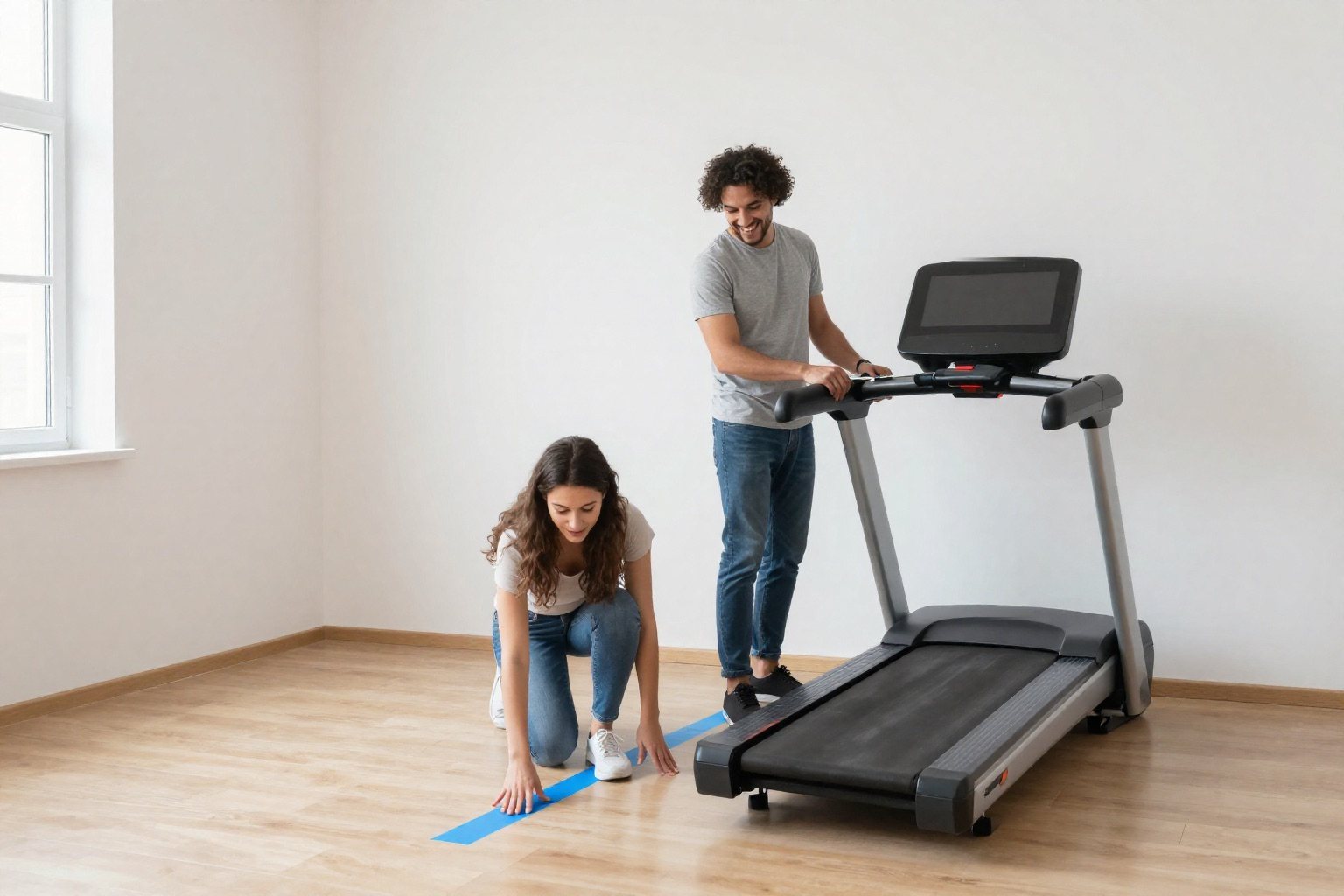
A home treadmill needs its own footprint, typically about 6.5 x 3 ft, plus free floor while it runs: manuals ask for 2 to 2.4 m (79 to 96 in) behind the deck and 0.5 to 0.6 m (20 to 24 in) on each side. That turns a 79 x 36 in machine into a rectangle of roughly 14.5 x 7 ft. Check the ceiling at full incline and the route to the room as well, then pick the machine.
Affiliate disclosureAs an Amazon Associate we earn from qualifying purchases made through links on this page. Commissions never change our ratings.
The clearance manuals ask for
Treadmill makers state a free zone around the deck, for passing by and for stepping off in an emergency. Two manuals we read put it like this:
| Manual | Behind the deck | Each side | Machine footprint |
|---|---|---|---|
| Schwinn 810 / 510T | 2 m (79 in) | 0.5 m (19.7 in) | 15,848 cm² stated |
| NordicTrack NTL16129.4 | 2.4 m (8 ft) | 0.6 m (2 ft) | 200 x 90 cm (6 ft 7 in x 3 ft) |
The U.S. design specification for motorized treadmills is ASTM F2115, but the clearance you have to respect is the one printed in the manual of your exact model. Where it is stricter than the figures above, it wins. Our treadmill space planner adds the clearance to any listed length and width for you.
Turning the listing into a floor rectangle
Take the NordicTrack example. A 79 in long, 36 in wide machine, plus 96 in behind and 24 in on each side, needs a rectangle of 175 x 84 in: about 14.6 by 7 ft, or 4.45 x 2.13 m. Most of that is empty floor, which is the point: it is where you land if you slip off the back. Keep it free of furniture, rugs, toys and the dog bed.
- Measure the room wall to wall, then subtract skirting boards, radiators and the swing of any door into that zone.
- Put the back of the treadmill towards the open side of the room, never towards a wall, a glass door or the top of a stairway.
- Leave the outlet within reach of the power cord at the front; manuals ask for a correctly grounded outlet.
Check the ceiling at full incline
Incline raises the front of the deck. Schwinn prints the figure for its 810: 40 cm (15.8 in) at maximum incline. A 6 ft (72 in) runner standing there is at about 88 in before the bounce of the stride, in a room with an 8 ft (96 in) ceiling. Basements and attics are where this bites. If the listing does not state a raised deck height, ask, and read our incline guide before you buy a steep deck for a low room.
Doors, stairs and floors
The box is the first obstacle. Full treadmills arrive heavy and long: the Schwinn 810 itself weighs 70.3 kg (155 lb) without packaging, and the 3G Cardio listing gives 216 lb. Measure doors, the turn at the top of the stairs and the lift before you order, and plan two people for the carry.
Then the floor. Manuals ask for a level surface, and NordicTrack also asks for a mat under the machine to protect the floor and carpet. A mat also stops the frame creeping on hard floors; our mats and desks guide shows how to size one to the footprint.
Folding saves storage space, not running space
A folding deck stands up against the wall between sessions, but the clearance above applies every time you unfold it. Fold-up also needs height: Schwinn reminds owners to check the clearance for the raised deck. Our folding treadmill checklist covers folded sizes, soft-drop decks and wheels, and the folding treadmill ranking shows how each pick folds. Short on floor for the running zone too? A walking pad needs far less; see our buying checklist to decide.
Our rated picks
The three best-rated models of our best home treadmills ranking, from the buyer review record and the listed specs.

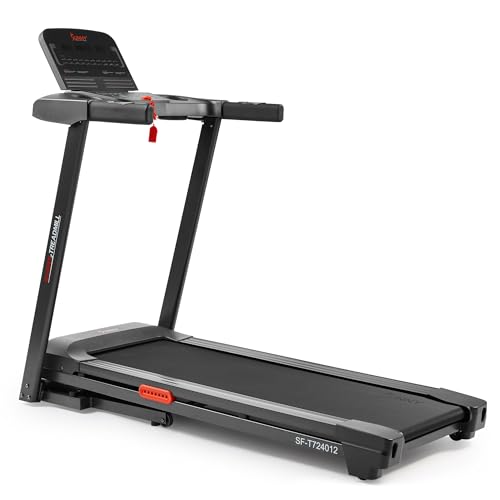

Product images: Amazon listings
Frequently asked questions
How much space do you need for a treadmill?
The footprint plus the clearance in the manual: about 2 to 2.4 m behind and 0.5 to 0.6 m on each side. For a 79 x 36 in treadmill that is roughly 14.5 x 7 ft of floor.
What are typical treadmill measurements?
Full home treadmills are often about 6.5 ft long and 3 ft wide (200 x 90 cm in a NordicTrack manual). Walking pads are closer to 4 ft by 1.6 ft.
How much ceiling height do you need for a treadmill?
Your height, plus the deck height at full incline, plus room for the bounce of your stride. The Schwinn 810 deck reaches 40 cm at full incline, so an 8 ft ceiling can be tight for tall runners.
Can a treadmill go against a wall?
The front or a side can be near a wall within the side clearance in the manual, but never the back: manuals ask for 2 to 2.4 m of free floor behind the deck.
Sources
- Schwinn (Nautilus, Inc.) — 810 / 510T treadmill: Assembly Manual / Owner’s Manual (consulted Nov 2026)
- NordicTrack (ICON Health & Fitness) — User’s Manual, treadmill model NTL16129.4 (consulted Nov 2026)
- ASTM International — ASTM F2115: Standard Specification for Motorized Treadmills (consulted Nov 2026)
Products mentioned
- MERACH Treadmill with 15/18% Auto Incline, 55"/47"x18"/19" Wide Belt Treadmills, 0.5-8.7MPH/10MPH 3.5HP Brushless Incline Treadmill for Home, 350LBS Foldable Treadmills with Screen & APP & Heart Rate (exact listing)
- UMAY Heavy Duty Treadmill with 20% Auto Incline for Home Gym (exact listing)
- Yagud Walking Pad Treadmill for Home Office, Portable Under Desk Treadmill with Remote Control and LED Display, Walking Jogging Running Machine for Home (exact listing)
- 3G Cardio Pro Runner X Treadmill - Heavy Duty Home Construction - FreeSync FTMS Bluetooth Connectivity - Low 6.5" Step-up Height - Foldable Compact Storage - Orthopedic Belt - 350 lb Capacity (exact listing)